
Personal Brand
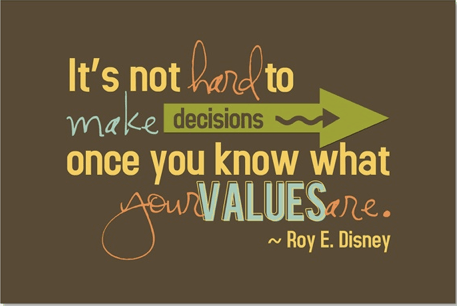
Do you have a personal brand? When your name is mentioned in personal or professional circles, what are folks saying about you? How does your manager think about you? How do your peers perceive you? Whether we want to admit it or not, we all have a personal brand. To further our careers, we should develop and strengthen that brand for the better. There is no better time than the beginning of the New Year to consider your brand. One way to enhance your professional game is to have a set of values that direct you individually. This set of values can help us ground our professional decision-making process in times of stress, when decisions are most crucial.
Below is the list of reminders I keep handy during difficult times. Some of the bullets have changed over the years, but many of them have remained unchanged. They serve as a reminder for me, and I share these as an example to everyone, in the hope that we all consider what we want to be known for in our respective disciplines. A few of my colleagues outside of HR have similar lists, and I’ve learned a lot from sharing these lists. I would appreciate it if you, the reader, could share your favorites in the comments below so we can all be exposed to new ideas. The following is a list of philosophies I try to keep in mind when making difficult decisions. I encourage everyone to conceptualize their personal brand for the new year.
Primary job
- My primary job-one, P0 (P Zero), an oath to the CEO and board, is to protect the company and make a return on investment for our investors. As the HR guy, I am not here to look out for individual employees. By protecting the company first, I am looking out for the individual employees. You can protect the company and have a great place to work.
OK with not pleasing everyone
- Successful HR practitioners understand that they will not always be able to please all the monkeys, I mean employees. Successful HR practitioners realize that someone will always disagree with a business decision. Solid business decisions will not be made if we worry about individual reactions. With 100 employees in a company, I will not make decisions based on the one or two individuals who speak out the loudest, even if they have a negative perspective. I must coach them to provide productive and constructive feedback or help them find a better-fitting corporate culture. Decisions must be made based on the long-term benefits of the company’s goals, not just the loudest voices. In the immortal words of Spock: “The needs of the many outweigh the needs of the few or the one.”
Trust matters
- As an HR practitioner, all I have is trust. When I lose the trust of an employee, my value as an HR professional is diminished. HR always asks for trust, but we must give reasons to be trusted. Transparency is a good first step to earning trust. Helping employees further their careers, increase their earnings, and secure new opportunities or promotions is a good step toward earning trust. If you want to earn trust, you need to give it.
Over-communicate
- I will make it HR’s responsibility to over-communicate company decisions to the departments and the company. I want the message to be conveyed to employees three times, in three distinct ways. Employees may disagree with a company’s decision from a personal standpoint. Still, my goal is to deliver an understanding so that there is at least professional RESPECT for the decision from a company perspective. When an employee is bitter about a company decision, it is usually due to a lack of understanding of how it was made. This is because the employee did not have the opportunity to hear the reasoning behind the decision.
- Big company decisions are hashed, debated, and marinated at the executive level over days, weeks, and maybe even months. Sr. leaders had a voice in the decision and the opportunity to present alternatives. Ideas were vetted against many other ideas and options. Individual employees are not afforded this luxury of visibility or exposure to the problems being solved over time. They may not understand a decision in a 2-minute announcement or a 300-word email. This is why the over-communication of company decisions is so important.
Paid on time
- Make sure that employees are paid on time and accurately. Be proactive and clear up individual questions about employee salaries when in doubt. Employees work for a paycheck. Apologies from accounting or HR won’t pay the bills.
My career, no one else
- I believe that we are ultimately responsible for our careers and destinies. Despite the manager, the VP, and the dick-headed co-worker who is making our lives miserable, it is up to me to take responsibility and action for my career. My manager is not responsible for ensuring I have a successful career. In my experience, many employees believe that their managers, and the manager alone, control their careers. As an HR Pro/Am, I can influence this mentality held by many employees.
Anything is possible
- If we could put a man on the moon in the 1960s with 64 kilobytes of memory, then in today’s age, where we can buy terabytes of storage off the shelf for PERSONAL use, we can do anything. It may take more time, resources, or people, but we can do anything. The word “can’t” should not exist.
Confidentiality is all I have
- I understand if an employee wants to share something confidently with me. I need to set the expectation that I must involve others if an employee or the company is at risk. I should coach and counsel, but allowing the company or an employee to be at risk is not an option. Hearing something confidently and then running to the CEO without employee permission is weak. Coach the employee to have conversations or volunteer to have the conversation with HR present.
Culture
- On hiring: No assholes. It doesn’t matter how smart they are, no assholes. If you are hiring an entire company of assholes, this can work. See? I am figuring out solutions.
- On culture: Culture is not Ping-Pong tables or beer Fridays. Culture cannot be turned up or down with “more or fewer toys or activities.” Effective corporate cultures will happen regardless of the values when the workforce is engaged and believes in the leader’s vision and values. A company can make a “Great Place to Work” list and still have a corporate culture that works for some employees but not for others. As individuals, we need to find a company with a corporate culture and products we can believe in. When employees believe in the leadership team and its vision, the company’s culture can propel it forward. When the employees don’t care about the leadership values or the vision, the company culture can put the company in a downward spiral.
- Culture thrives when hiring practices align with the company’s values. Bringing someone who prefers shorts and flip-flops into a suit-and-tie culture doesn’t work. Bringing on a brilliant asshole to a No Asshole culture is not going to work. Bringing an asshole to an asshole culture CAN work. No employee is for every company. Not every company is for every employee. Culture can start with the job description by attracting and weeding out specific behaviors. Culture is reinforced during the interview and onboarding of a candidate turned new hire. Culture thrives when management and HR collaborate to reinforce shared values. Letting behavior counterproductive to the culture go unchecked causes apathy to those reinforcing the culture.
Anyone can give a monkey a raise
- Being successful in HR means being able to earn the respect of the team while executing tough and challenging business decisions. Any monkey can give a raise. Any monkey can maintain respect for the easy and obvious company decisions. The 800-pound gorillas can conduct layoffs and ensure everyone is treated with dignity. They will assist, counsel, and coach those seeking their next gig.
Give the benefit of the doubt
- Successful HR practitioners can appreciate and articulate that everyone enters the building with a different background, and these personal experiences will affect their perception and interpretation of the work environment in various ways. When unsure of what to do, giving the benefit of the doubt is a good approach. Every new employee who joined the company was excited and eager to make a fresh start. If this attitude changes, then something is behind that change. Employees don’t wake up one morning and decide to be assholes at work.
And my all-time favorite:
It is better to keep one’s mouth shut and let everyone think you are a fool than to open it and remove all doubt.
Let me know what philosophies ground you in your day-to-day practice. The exercise of putting our beliefs down on paper will make anyone stronger by forcing us to think about how we go about and articulate our day-to-day lives.
See you at the after party,
HRNasty
nasty: an unreal maneuver of incredible technique, something that is ridiculously good, tricky, and manipulative but with a result that can’t help but be admired, a phrase used to describe someone good at something. “He has a nasty forkball”.
If you feel this post is valuable, please subscribe here. I promise no spam,
and “like” us on Facebook. I read all the comments below.Thank you!


Leave a Reply